How Much Do Your Cleaning Chemicals Really Cost per Job? A Guide for NZ Cleaning Businesses
Alex & Alex / The Practicalists
The bottle price is only the beginning. A practical guide to chemical costs, accurate dosing and better comparisons for NZ cleaning businesses.
See the worked example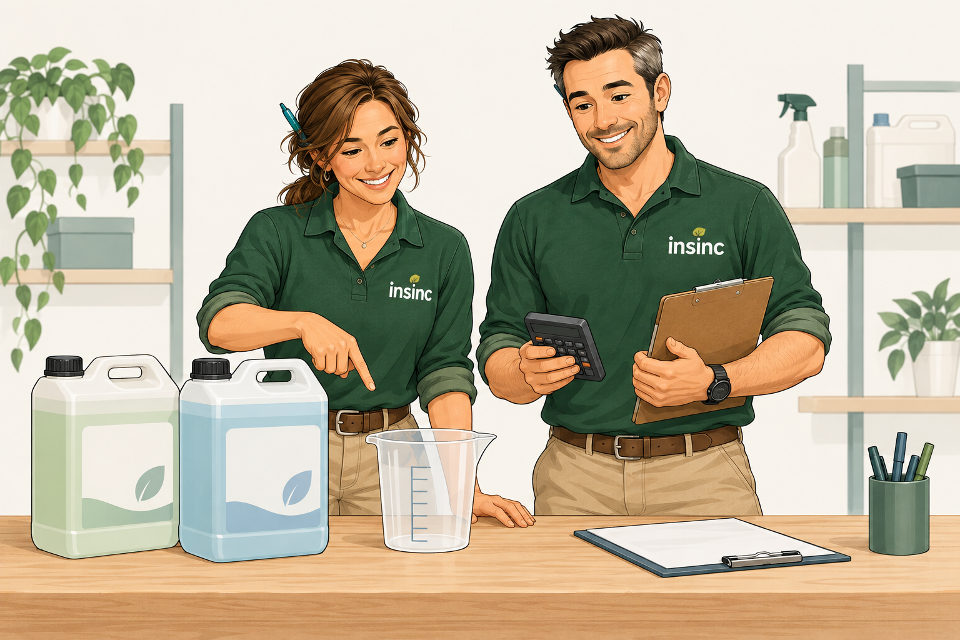
Quick answer
Divide the container price by its volume in millilitres. Multiply by the label-directed dose per litre of finished solution, then by the litres prepared for the job. Compare labour and repeat work separately. A lower chemical cost only helps if the method achieves the required result.
01 / Compare the whole job
Look beyond the bottle price.
A $60 cleaner can cost more to use than an $85 cleaner. For contractors and facilities teams, dose, prepared volume and cleaning time all affect the comparison.
Same task
Compare products suited to the same surface, soil, equipment and required finish.
Actual use
Use the label rate for your task, including required contact time and rinsing.
Work completed
Count preparation, active cleaning time and any repeat work needed.

What Alex would ask
What happens at the bucket?
- Is the dose measured or poured by eye?
- How much solution is prepared, including any discarded?
- Does the method meet the agreed cleaning standard?
- Are both prices on the same GST basis?
02 / Run the numbers
Calculate cost per prepared litre.
This calculation covers chemicals only. Water, labour, equipment and other operating costs are separate.
× dose (mL per finished litre)
= chemical cost per prepared litre
Illustrative figures in NZD excluding GST. These are not Insinc prices or recommended doses. Assume both products suit the same task and achieve an acceptable result.
$60 per 5 L container
per prepared litre
$60 ÷ 5,000 × 20 = $0.24
$85 per 5 L container
per prepared litre
$85 ÷ 5,000 × 10 = $0.17
Cleaner B costs seven cents less per prepared litre in this example. This calculation does not establish which product performs better.
Then calculate cost per visit.
Multiply the cost per prepared litre by all solution prepared, including leftovers. For several products, calculate each separately and add them together.
An 8-litre visit
Across 22 visits
03 / Include labour
Five extra minutes matter.
Suppose a product saves $0.50 in chemicals but adds five minutes of work. At an illustrative total labour cost of $36 per hour:
extra labour per visit
Less the $0.50 chemical saving means the visit costs $2.50 more overall.
Use your actual labour cost. Passive contact time may not add labour if staff can complete another task while waiting.
The Practicalist Take
Cost the finished job.
Include the time needed to prepare, clean, rinse and correct an unsatisfactory result.
Practical Sustainability™: measure dosing and waste before claiming that a change saves money or resources.
04 / Read the directions
Water or finished solution?
20 mL added to 1 L of water makes approximately 1,020 mL. 20 mL used to make 1 L of finished solution makes 1,000 mL. Follow the label wording when calculating yield.
If a manufacturer defines 1:50 as one part concentrate to 50 parts water, that means 51 total parts. Ask if the ratio is unclear.
Use the dose for the work you actually do. Never weaken a product beyond its instructions to improve the apparent cost. Required disinfectant concentration and contact time must be maintained.
Keep this reference handy
Insinc chemical dilution chart
Find the ratio specified for your product, then read across to the required solution volume. The cells show concentrate quantities from Insinc's published chart.
Quick reference, not an exact dosing formula. The published figures include approximations and do not all follow one exact ratio calculation. Confirm the manufacturer's ratio convention and mixing instructions before use. For costing, use the actual label-directed dose and prepared volume.
On a small screen, swipe across the table to see every column.
| Published ratio | 750 mL | 1 L | 5 L | 10 L |
|---|---|---|---|---|
| 1:1 | 375 mL | 500 mL | 2.5 L | 5 L |
| 1:2 | 250 mL | 333 mL | 1.67 L | 3.3 L |
| 1:3 | 187 mL | 250 mL | 1.25 L | 2.5 L |
| 1:4 | 150 mL | 200 mL | 1 L | 2 L |
| 1:5 | 125 mL | 166 mL | 833 mL | 1.66 L |
| 1:10 | 68 mL | 90 mL | 454 mL | 910 mL |
| 1:20 | 36 mL | 50 mL | 250 mL | 500 mL |
| 1:30 | 24 mL | 32 mL | 160 mL | 320 mL |
| 1:40 | 18 mL | 25 mL | 125 mL | 250 mL |
| 1:50 | 15 mL | 20 mL | 100 mL | 200 mL |
| 1:60 | 12 mL | 16 mL | 82 mL | 165 mL |
| 1:80 | 9 mL | 12 mL | 62 mL | 125 mL |
| 1:100 | 7 mL | 10 mL | 50 mL | 100 mL |
Source: Insinc Chemical Dilution Rate Chart . This general chart does not establish a suitable dose for a particular product, surface or hygiene task.
How does a measured dose become a job cost?
Multiply the container price per millilitre by the concentrate actually required for the job. In our hypothetical Cleaner A example, an 8 L batch at 20 mL per finished litre uses 160 mL. The chemical cost is $60 ÷ 5,000 × 160 = $1.92. The chart is a mixing reference; the product instructions determine the dose.
Three places costs creep up
Unmeasured dosing
Pouring 150 mL when 100 mL is required uses 50% more concentrate. Check measuring equipment and pump output.
Oversized batches
Prepare suitable quantities. Do not keep dirty solution in use or store diluted products beyond their permitted use period.
Leaks and idle stock
Check lids, taps and bottles. A bulk pack offers little value if some expires, deteriorates or is never used.
Concentrate or ready-to-use?
Concentrate
Calculate the cost from price, dose and prepared yield. Include mixing time, dispensing equipment and staff training.
Ready-to-use
Divide the price by the usable litres supplied. Check application amount and container turnover. Only dilute if the manufacturer permits it.
Neither format automatically wins. Compare the same task, frequency of use and result.
05 / What to measure
Trial one task. Track the result.
-
Set the standard
Choose a representative task. Agree the finish, surface and equipment before comparing products.
-
Record each visit
Note price, dose, litres prepared, work completed, active labour and any repeat cleaning.
-
Compare fairly
Repeat across several normal visits. Account for heavier soil or extra work before drawing conclusions.
How do I check monthly chemical costs?
Record opening stock, purchases, transfers and closing stock. Value stock consumed consistently, then divide its chemical cost by completed visits. Keep GST treatment consistent and account for delivery where relevant. Purchases that build stock are not the same as consumption.
Where Insinc can help
Match the cleaner and the dose.
Shortlist suitable products, check their instructions and trial the method before standardising it across sites.
Accurate dosing
Check volume markings, compatibility and output.
Measuring jugs →Portion and container pumps →
One practical next step
Start with one regularly used cleaner.
Measure the dose and batch size on your next job, or use our check-up to start reviewing your workplace supplies.
Take the 60-second check-upThe questions we hear
Cleaning chemical cost FAQs
Is the cheapest five-litre cleaner cheapest to use?
Not necessarily. A higher-priced concentrate may need a smaller dose. Compare suitable products for the same task, including labour and repeat work.
Does a larger container always save money?
No. Compare unit price, delivery, storage, dispensing arrangements and likely consumption. Unused or wasted stock can cancel the benefit.
Can I reduce the dose to cut costs?
Stay within the manufacturer's directions. Improve measurement, batch sizes and product fit rather than using a weaker-than-directed solution.
Which dilution rate should I use in the calculation?
Use the rate for the specific task. Calculate separate costs if one cleaner has different doses for routine cleaning and heavy soil.
Where should I start without cost records?
Choose one frequently used chemical at one regular site. Record the dose, solution prepared, visits and repeat work to build a manageable baseline.
Keep improving the method
Reduce repeat cleaning
Investigate the process behind a poor result.
Why café floors stay greasy after mopping →Need help choosing? Ask Insinc.
https://www.insinc.co.nz/category/cleaning-products-supplies.html