
Alex & Alex · The Practicalists
Wrapping lunch and baking cookies need different checks
Two rolls of paper sit on the kitchen shelf. One is used to wrap sandwiches; the other lines baking trays. They look similar enough, especially when someone has thrown away the cartons.
That is where a simple packaging choice can turn into stuck food, wasted sheets or paper used in conditions it was never intended for.
Alex & Alex explain how to compare greaseproof paper and baking paper for New Zealand cafés, bakeries and food-service kitchens.
Quick answer: greaseproof paper or baking paper?
Greaseproof paper is a starting point for wrapping food and lining serving trays where resistance to grease matters. The name alone does not confirm non-stick performance or suitability for oven use.
Baking paper, often sold as baking parchment, is designed for baking applications and food release within the manufacturer's stated conditions.
Choose by the task, then check the exact product. Food-contact suitability, temperature limits and use instructions matter more than colour or how the paper feels.
A practical comparison for your kitchen
| The task | What to consider | The key check |
|---|---|---|
| Wrapping sandwiches or bakery purchases | Food-contact greaseproof paper or a suitable food wrap | Does it suit the food's grease, moisture and temperature? |
| Lining a serving basket or tray | Greaseproof sheets sized to the serving area | Does the liner hold up for the expected serving time? |
| Baking cookies or lining a cake tin | Baking paper approved for the recipe and appliance | Check heat limits, baking duration and release instructions. |
| Reheating a wrapped item | Wrapping specifically approved for that heating method | A serving wrap is not automatically a reheating wrap. |
| Packing food with plenty of sauce | A suitable food container, with a liner only if useful | Grease resistance does not establish liquid-tight performance. |
01 · Wrapping and serving
Use greaseproof paper where grease resistance helps
For a sandwich, pastry or lined serving basket, start by checking how the paper performs with the actual food. A dry scone and a warm, buttery pastry can make very different demands on a wrapper.
- Confirm the paper is suitable for direct food contact.
- Check suitability for hot, cold, fatty or moist foods as relevant.
- Choose enough coverage for a secure wrap without excessive overlap.
- Trial it for the time the food will spend wrapped or on display.
Inspect the outside for grease transfer and check whether the paper tears or sticks when the customer opens it.
What Alex would ask: “Does it still work after the customer's walk back to the office?”


02 · Baking and food release
Choose baking paper for the baking process
When lining a baking tray or cake tin, look for a product specifically intended for that use. Baking paper commonly has a release surface that helps baked food separate from the liner.
Follow the product's directions on preparation and greasing. Do not assume that ordinary greaseproof wrapping paper will release a batch of cookies in the same way.
Before changing your kitchen's usual paper, test an approved alternative with one normal batch. Check how easily the food lifts away, whether the sheet stays intact and how much cleaning is needed afterwards.
03 · Heat suitability
Read the packaging before the paper goes into the oven
There is no single temperature limit to apply to every food paper. Check the instructions for the exact product and the appliance you are using.
- Intended use: does the manufacturer approve it for baking?
- Temperature: is your recipe within the stated limit?
- Duration: are there restrictions on heating time?
- Appliance: is it suitable for that oven or heating method?
- Placement: can it stay clear of heating elements and flames?
Keep baking paper away from direct heat sources and do not use it under a grill. Trim excess paper so it does not hang over the tray towards an element.
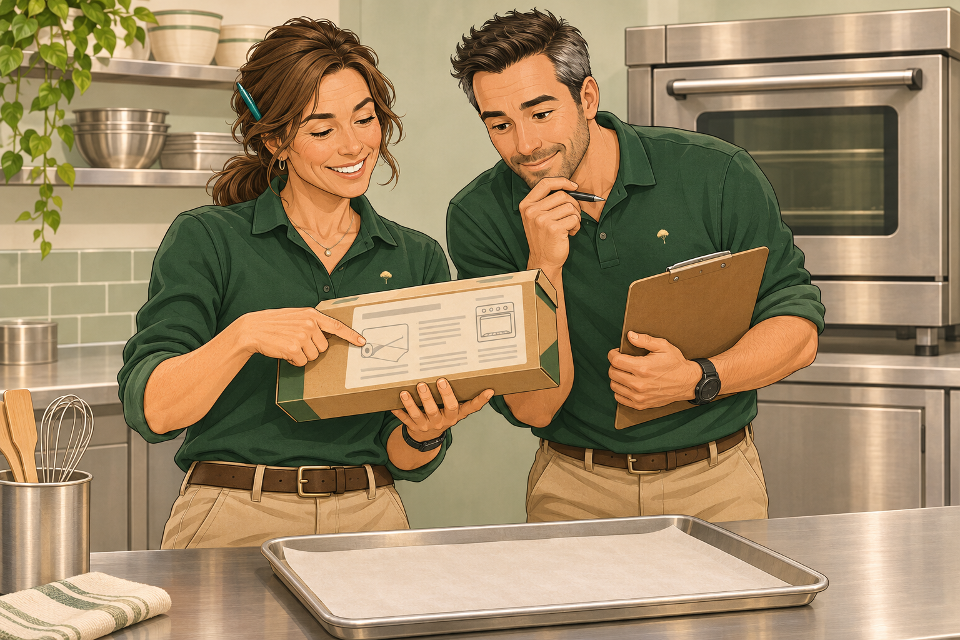
If a loose roll has no identification or instructions, set it aside until you can confirm what it is. Appearance is not a reliable heat-suitability test.
Waxed paper is another product to identify carefully
Waxed food wraps may be useful for suitable wrapping and serving tasks, but they should not be substituted for exposed baking-tray liners. Keep wrapping supplies clearly labelled and separate from your approved baking paper.
04 · Size and workflow
Choose rolls or sheets around your busiest jobs
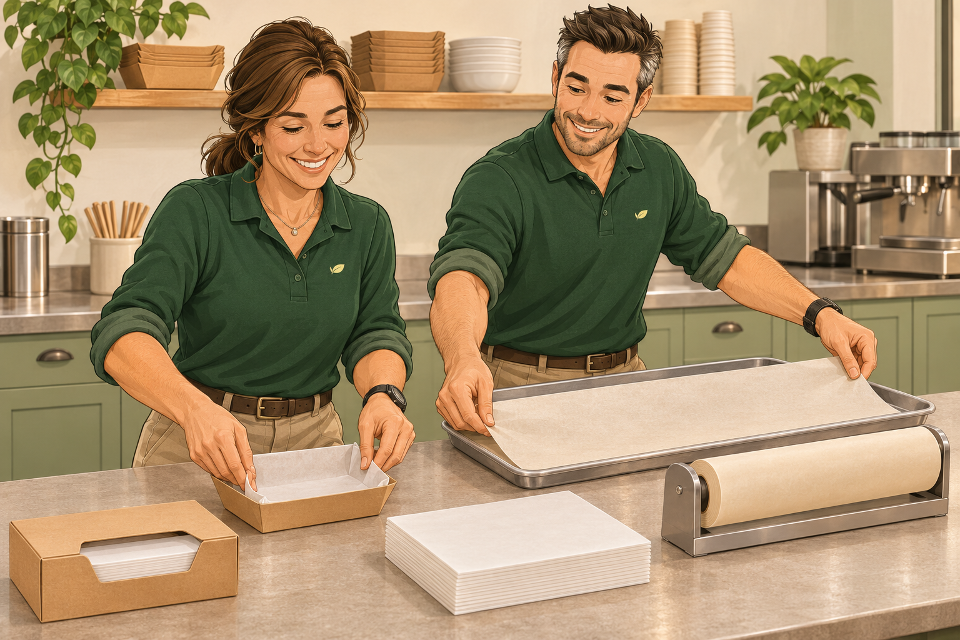
Rolls let staff cut different lengths for varied portions and tray sizes. Check the roll width first: cutting a longer piece does not make it wider.
Precut sheets can simplify repeat tasks when the sheet matches your usual tray or food portion.
- Measure the tray's internal base and any lining needed up the sides.
- Trial a sheet around your typical sandwich or pastry.
- Check how much trimming each format creates.
- Keep the dispenser accessible and protected from splashes.
What Alex would ask: “Are we buying the right size, or cutting away the same extra strip every day?”
Paper options to compare at Insinc
Use these as starting points when reviewing your supplies. Confirm the current product instructions before choosing paper for a particular food or heating process.
Matthews Greaseproof Paper Roll
A white 300mm × 120m roll listed at 40gsm. Consider the width and cut-to-length format for your wrapping and serving routine.
Confirm suitability for your intended food and use.
View greaseproof rollCommercial baking paper rolls
Insinc's baking range includes Matthews white 45gsm rolls in 300mm, 400mm and 450mm widths, each 120m long.
Compare the width against your trays and check the product's baking instructions.
Browse baking paperConfoil parchment baking sheets
The baking range also lists Confoil vegetable parchment sheets in 400 × 600mm and 405 × 710mm formats.
Compare precut sizes when your team repeatedly lines the same trays.
Compare baking sheetsFor more wrapping formats, explore Insinc's greaseproof paper and food-wrap sheets or the wider food wrap range.
Practical sustainability starts with the amount you use
Look for avoidable waste in the daily routine: oversized sheets, repeated trimming, damaged stock and food that sticks to unsuitable paper.
Compare the cost per successfully wrapped item or lined tray, including preparation time and wasted material.
For disposal, check the specific paper's coating, food contamination and your waste collector's acceptance rules. A brown finish or the word “paper” does not establish a recycling or composting pathway.
Frequently asked questions
Is greaseproof paper the same as baking paper?
No, the terms should not be treated as interchangeable. Greaseproof describes resistance to grease; baking paper is intended for baking under specified conditions. Some products may suit several tasks, but check their instructions.
Can greaseproof paper go in the oven?
Only when the manufacturer explicitly approves that product for the intended oven use. The word “greaseproof” by itself does not confirm heat suitability or non-stick performance.
Can baking paper be used to wrap food?
It may be suitable if its food-contact instructions cover the intended use. Check how well it folds and holds the wrapping, and compare its cost with a dedicated food wrap.
Is brown paper more heat-resistant than white paper?
Colour does not establish heat resistance. Use the product's stated temperature limit and directions, regardless of whether it is white or brown.
Should we grease baking paper?
Follow the paper manufacturer's instructions alongside the recipe. Many baking papers provide a non-stick surface, but preparation requirements can vary.
Are rolls or precut sheets better value?
Compare them using your actual workload. Rolls offer flexible lengths; precut sheets can reduce preparation when the size fits. Include trimming waste and staff time in the comparison.
Your 60-second food-paper check
- Task: are you wrapping, serving, baking or reheating?
- Food: is the paper suitable for its grease, moisture and temperature?
- Heat: have you checked the exact product's instructions?
- Fit: does the sheet suit the tray or portion?
- Identification: can every team member tell which paper to use?
Need help comparing options? Tell Insinc what you are preparing, your tray or portion size and whether the paper will be heated.
Ask Insinc about food paper